
Transform your enterprise data with expert Microsoft Fabric consulting services. Our Microsoft Fabric consultants help you plan, implement, migrate, optimize, and manage your Fabric environment.
Microsoft Fabric Consulting Services can be defined as a complete ecosystem that unifies data engineering, warehousing, real-time intelligence, and Power BI on Microsoft's one-lake platform. Hexaview Technologies is the Microsoft fabric consulting partner, we plan, implement and support fabric environments to help regulated Enterprises move from scattered systems to a governed AI-ready data estate.

Delivering 16+ years of excellence



.webp)
.svg)



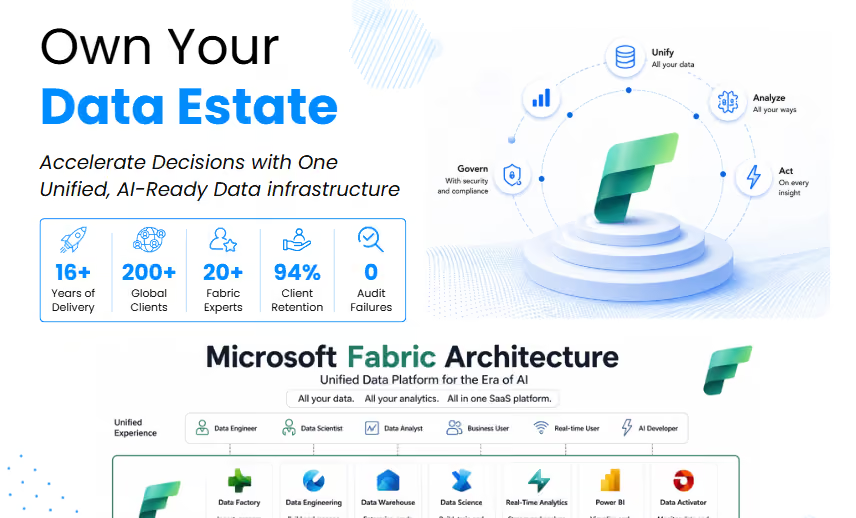
Rather than configuring and governing separate services for pipelines and dashboards, Fabric runs all core workloads on the same OneLake storage layer. The information below breaks down each workload and what it does for your data environment.
170+ connectors and easy pipelines that can bring data in one place without the need for separate management tools.
T – SQL storage and Spark-based data house keep in the same One Lake version of your data.
Data Lake reports, which avoid the slow refreshing process that older systems mostly rely on.
KQL databases and event streams can now be used within seconds, rather than waiting for nightly updates later.
No code triggers an alert or action at the immediate moment a value passes apreviously set limit.
Simple analytics and secure chat assistance, which is built from your real, approved business data only.
The Microsoft Fabric consulting services at Hexaview span the six connected workstreams, from initial strategy through managed support. Microsoft Fabric migration services are a core part of our offering, whether you’re moving off Azure Synapse, Databricks, or a legacy on-premises warehouse, we stage the cutover around your live reporting schedules so nothing breaks mid-transition.
This ensures that capacity planning and governance are never left as after thoughts.
Architectural design, readiness assessment and capacity cost modelling to ensure your Microsoft fabric implementation starts with a budget your CFO can confidently approve.
Typical outcome: a funded roadmap in 2 to 3 weeks
Complete deployment, Lakehouse set up and fabric workspace configuration, managed by certified Microsoft fabric consultants rather than General IT teams.
Typical outcome: first workload live in 6 to 10 weeks
Databricks, Azure Synapse, and Azure Data Lake storage migration are planned around the reporting schedule. Full testing is done before the legacy system is turned off.
Typical outcome: zero-downtime cutover
KQL databases, event streams, and One Lake integration that convert operational data into alerts. Hence, it helps your team to respond the same day rather than waiting for quarterly reports.
Typical outcome: batch-to-real-time in one sprint
ML model integration, Fabric Copilot activation, and a governance semantic layer enable natural language analytics to be used seamlessly across the business.
Typical outcome: a working Fabric data agent inside 30 days
24/7 Fabric operations, SLA-backed support and governance give ongoing help rather than only a handover document.
Typical outcome: 90-day performance review built in
Most data teams run too many tools that do not talk to each other. Microsoft Fabric puts engineering, warehousing, real-time analytics, and Power BI on one platform. A good consulting partner makes sure you get the value without the rollout headaches. According to Microsoft Report, customers reported results like these:
A composite organisation built from customer interviews saw a 379% ROI over three years, with payback in less than 6 months. We help you get there by scoping the rollout in phases and sizing capacity before you spend.
Data engineering productivity rose by 25%, and time spent searching, integrating, and debugging data dropped by 90%. We build clean pipelines on OneLake so your engineers spend their time on new work.
Analysts cut the time needed to produce output by 20% because they could reach more current data without waiting on engineering. We design the semantic layer so everyone reads from the same trusted source.
The study's organisation retired 30% of its legacy analytics infrastructure, including old SQL servers, cubes, and duplicate tools. Our migration plans identify what can be switched off, and when.
Fabric helped cut team turnover by 8% in the study, since people spent less time on manual data wrangling. Our handover training means your team can run the platform confidently.
We run old and new environments side by side and move over only after testing. Access policies, sensitivity labels, and audit logging are set up at the start, not added after go-live.
A Microsoft Fabric consultant earns trust through proven experience and certified expertise. Our team can help businesses plan, build, and manage their Microsoft Fabric solutions to deliver measurable business value.

Get a quick overview of our Microsoft Fabric consulting services and how we help organizations scale with data.
Every Microsoft Fabric engagement follows a structured five-step process, one that keeps honest timelines, governance intact, and your team informed at every stage of it.
Timelines reflect a standard engagement scope. Complexity, data volume, and source system count may extend individual phases.
Regulated, data-intensive sectors where clarity and speed of insight decide competitive outcomes.
Real-time fraud signals and risk dashboards on Eventhouse, replacing overnight batch reporting with intraday visibility. Governance controls and access policies are configured to support FINRA data retention and auditability requirements.
Lakehouses aligned to HIPAA requirements that unify EHR, claims, and operational data, with sensitivity labels, audit logging, and access controls configured at implementation rather than retrofitted after go-live.
Lakehouses aligned to HIPAA requirements that unify EHR, claims, and operational data, with sensitivity labels, audit logging, and access controls configured at implementation rather than retrofitted after go-live.
Unified customer, inventory, and campaign data with Power BI dashboards refreshed innear real time through Direct Lake
Real-time intelligence from plant sensors feeding predictive maintenance models without a separate streaming stack
Logistics & Supply Chain, Public Sector, and Education: Fabric engagements scoped case by case; ask us for sector-specific references
The best thing about Microsoft Fabric is how it natively blends into your Azure environment. You get a fully connected data ecosystem from day one.
Explore how our clients are driving growth and innovation


Hexaview delivered our MS SQL project on time with exceptional precision and attention to detail. Their expertise was evident throughout the implementation, ensuring seamless integration with our existing systems. What truly sets them apart is their proactive communication and customer-centric approach - they kept us informed at every step and adapted quickly to our evolving needs. The project was completed exactly as specified, and their ongoing support has been outstanding. Hexaview has earned their position as our trusted technology partner.

The data lake built by Hexaview Technologies has fundamentally shifted how we manage and utilize data across our organization. Our internal users now have seamless access through microservice and data transformation tools, while our external clients benefit from smooth integration with our portal and data service tools. What sets Hexaview apart is their deep understanding of both the technical architecture and the business implications.
.svg)
.webp)
In our recent collaboration, Hexaview demonstrated deep expertise in Artificial Intelligence, particularly in Large Language Models and DialogFlow. They invested significant time understanding our specific challenges and vision before proposing solutions. This thoughtful approach resulted in a sophisticated AI-driven system that precisely addresses our business needs. Their ability to translate complex AI capabilities into practical business applications was exactly what we needed. The solution they delivered is both technically advanced and practically useful.



Can't find the answer you're looking for? Our FAQ section provides quick, helpful information on our products, services, and policies.
Microsoft Fabric consulting is advisory and delivery work that helps an organization assess, design, implement, and operate Microsoft Fabric, the unified SaaS platform for data engineering, warehousing, real-time intelligence, and Power BI built on OneLake.
A readiness assessment and funded roadmap typically takes 2 to 3 weeks. The first workload is typically live within 6 to 10 weeks of engagement start. Full migration from a legacy data environment such as Azure Synapse or Databricks — including parallel operation testing before cutover — typically takes 3 to 6 months depending on data volume, source system count, and reporting complexity. For regulated industries, compliance validation and governance configuration add to the timeline. Hexaview provides specific timeline estimates after the readiness assessment is complete, not before.
A Microsoft Fabric consultant assesses your current data estate, designs the OneLake and capacity architecture, builds and migrates pipelines and semantic models, and supports governance and performance after launch, so the platform keeps working as your data grows.
Cost depends on the scope of the data estate, the number of workloads being migrated, whether AI and Copilot enablement is included, and whether ongoing managed service is required. Hexaview offers a fixed-fee engagement option for clearly scoped projects. A readiness assessment is typically the first step — it produces a funded roadmap and cost model that an organization can use to make an implementation decision before committing to full delivery costs. Microsoft Fabric platform pricing is separate and capacity-based; details are available on Microsoft's official Fabric pricing page.
Azure Synapse Analytics is Microsoft's separately licensed analytics service, requiring organizations to provision and govern it as a standalone product. Microsoft Fabric brings similar data engineering and warehousing capabilities into a single unified SaaS platform built on OneLake, alongside Power BI, real-time intelligence, Data Factory, and AI capabilities in one governed environment. Microsoft is actively investing new capabilities — Lakehouse, Direct Lake mode, Real-Time Intelligence, and Copilot — in Fabric rather than in Synapse. Organizations evaluating a move typically do so to consolidate tooling and gain access to capabilities not available in Synapse, not because Synapse has been withdrawn.
In most cases, yes. Fabric's Data Warehouse and Lakehouse components can take over reporting and analytical workloads from a legacy warehouse, often run side by side with the old system during a phased migration so nothing breaks during cutover.
Yes. Hexaview operates a managed service for Microsoft Fabric environments under a defined SLA as a separate, ongoing engagement — not a warranty period attached to the implementation. The managed service covers performance monitoring, SLA-backed incident response, governance reviews, capacity optimization, and a 90-day performance review cycle. Organizations can continue with Hexaview as their managed Fabric partner indefinitely after implementation.
No. A Fabric data agent is a governed, conversational layer that reads your actual lake house, warehouse, or Power BI semantic model and answers questions using your real data, respecting whatever Microsoft Purview access rules already apply
Microsoft Fabric security runs on Microsoft Entra ID and Microsoft Purview controls, with row-level and table-level access inside OneLake and sensitivity labels applied at ingestion. Fabric Copilot and Data Agents operate within the same governance layer — they only surface data that the querying user is already permitted to see, which is critical for regulated industries where data access is tightly scoped. Hexaview configures governance controls, audit logging, and access policies at the start of each engagement rather than retrofitting them after the platform is live. For clients with FINRA, HIPAA, or SOC 2 obligations, these requirements are mapped to specific Fabric configuration decisions during the readiness assessment.
Not necessarily, but it depends on your workload mix. Microsoft Fabric handles governed BI, real-time reporting, and general-purpose data engineering well enough to replace Databricks for most enterprise analytical use cases. Organizations doing advanced machine learning, large-scale MLOps, or complex Spark workloads may still benefit from Databricks running alongside Fabric, connected through Unity Catalog mirroring so teams share data without duplication. The right answer depends on the specific workloads involved, not a blanket platform comparison.
Ask for the number of active Microsoft Fabric certifications on the team, specifically DP-600 (Fabric Analytics Engineer) and DP-700 (Fabric Data Engineer). Ask whether the partner has delivered Fabric implementations in your industry, and request references from clients in regulated sectors if that applies to your organization. Ask how the partner handles the transition from your current platform — Azure Synapse, Databricks, or a legacy warehouse — and whether they run the old and new environments in parallel before cutover. Ask who owns the delivery: whether you will work with senior architects throughout the project or whether work is handed to junior resources after the initial scoping call. Hexaview provides certified team credentials on request and assigns dedicated delivery teams with senior architects throughout the engagement.
A readiness assessment is a structured 2 to 3 week engagement in which Hexaview audits your existing data estate, maps your current tools and pipelines, identifies governance and compliance requirements, and produces a funded implementation roadmap with a capacity cost model. The output is a concrete plan — not a slide deck — that includes architecture decisions, a phased migration sequence, a Fabric capacity and SKU recommendation, and a cost model your CFO can approve before any platform spend is committed. Organizations that proceed with a readiness assessment have a fixed point of reference for the full implementation, which reduces scope creep and timeline risk.
Microsoft Fabric Copilot is a natural language interface built into the Fabric platform that allows business users to query data, generate reports, and navigate the data estate using plain English rather than SQL or DAX. It is not a general-purpose AI — it only surfaces data that the querying user is already permitted to see under Microsoft Purview access controls. For regulated industries, the key configuration requirement is a correctly built semantic layer that restricts which data sources Copilot can access. Hexaview configures the semantic layer as part of the AI and Copilot enablement workstream, ensuring Copilot only operates within approved, governed data before it is enabled for business users.
Whether you are moving away from Power BI Premium, combining Synapse pipelines, or planning for the first Fabric Data Agent, our Microsoft Fabric consultant starts with a working session, not a sales pitch.


.svg)


.svg)