
Imagine you are the head of strategy at a mid-sized company. You sit down on a Monday morning and ask a simple question: "What was our revenue last week?"
Three people answered. The finance team says it is 4.2M. The sales team says 4.6M. The data analytics team says 4.1M. All three numbers come from the same company. All three are different.
Now consider what that moment costs your organization not just in time spent figuring out which number is right, but in the decisions that were made based on the wrong number last week, last month, last quarter.
Most companies don't plan their data systems they grow into them. A CRM here, an ERP there, an e-commerce platform somewhere else. Each tool storing its own version of your data, never really reconciled with the others.
So, when someone pulls a report, they're pulling from their system. Not the system. Because there is no "the system."
And it compounds. Nobody agreed on what "clean data" means, so one team works with raw numbers, another with half-processed ones. Pipelines break overnight, and reports still run in the morning on bad data. A business rule changes and you need to recalculate last quarter, but the original data was overwritten. It's simply gone.
The real cost isn't the Monday morning argument. It's every decision quietly, confidently made on the wrong number. Last week. Last month. Last quarter.
Medallion Architecture was designed specifically for this problem. One source of truth. Clear quality standards at every stage. Data your entire organization can trust. So the next time someone asks "what was our revenue?", everyone is finally looking at the same answer.
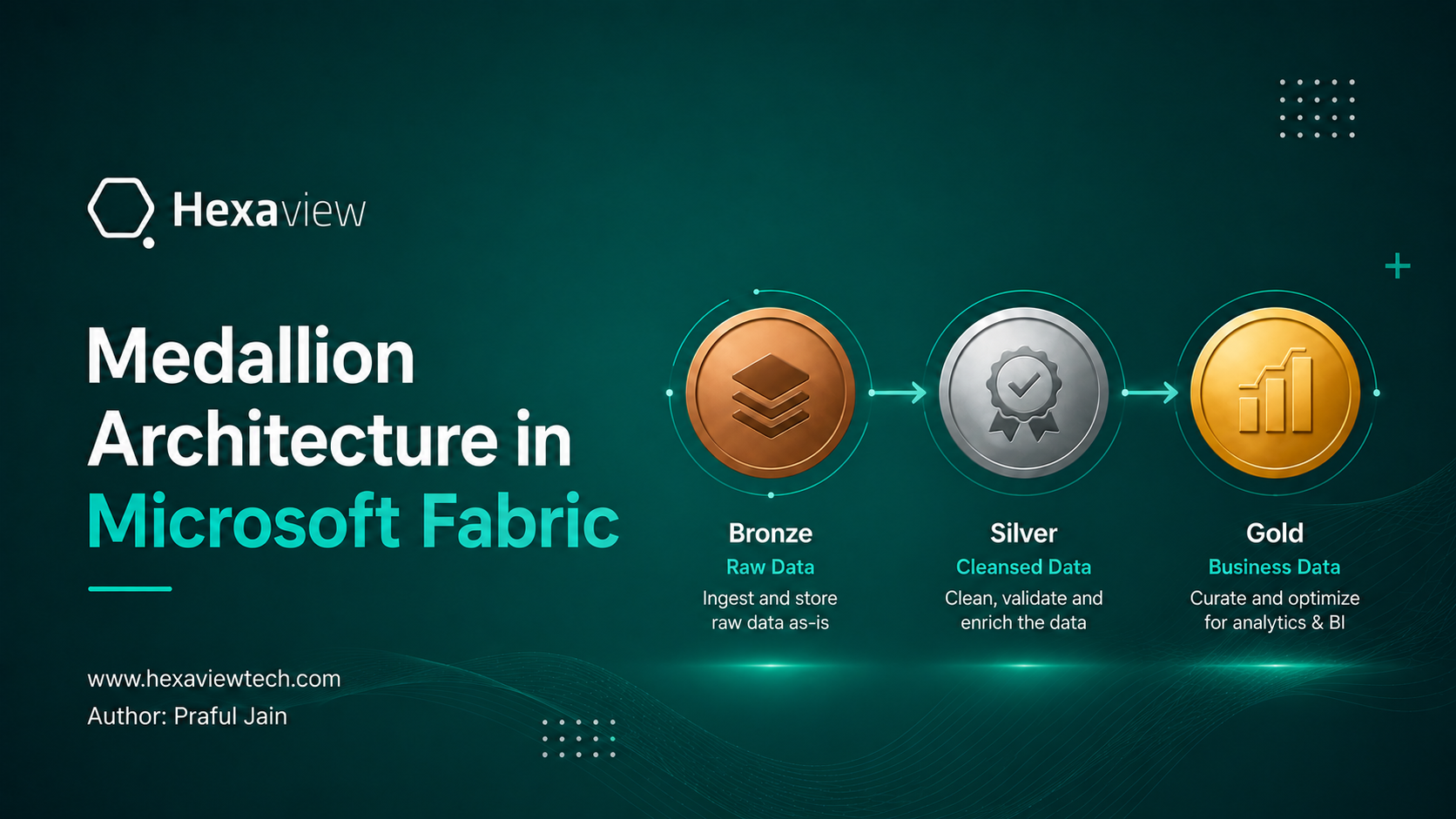
Medallion Architecture is a way to organize an organization's data into three layers, where each layer represents a different stage of data processing and quality.
These layers are called Bronze, Silver, and Gold. The names are easy to understand:
Each layer has:

This three-zone model was originally developed by Databricks (a leading data engineering company) and has been adopted as an industry standard. Microsoft Fabric has built it directly into its platform design, making it the recommended approach for all data engineering work on Fabric.
The architecture works because it enforces one rule above all others: data only moves forward. Raw data goes into Bronze. Bronze gets processed into Silver. Silver gets shaped into Gold. Nothing in a higher layer ever reaches back and modifies a lower layer. This one rule is what solves the replay ability problem.
Every morning, your custodians and your banking partners drop yesterday's performance files into your system. Each file comes in its own format. One sends a CSV. Another sends an Excel. A third sends a fixed-width text file. Some have missing values. Some have settlement mismatches. Some arrive late.
And by 9am, your portfolio team is already asking: "What was yesterday's portfolio performance?"
This is exactly where things break if you don't have a structured way to receive, clean, and serve that data. Medallion Architecture gives you that structure.

Bronze is the first and most fundamental layer. Its job is deceptively simple: receive every piece of data from every source and keep it forever, exactly as it arrived.
Think of Bronze as a loading dock and warehouse combined. Every truck that arrives unloads its cargo here. The cargo is inventoried and stored but not inspected for quality, not repackaged, or not processed. That happens later. The loading dock's job is simply to make sure nothing gets lost in transit.
Bronze is the foundation of trust in the entire system. Because Bronze data is never modified, it is always possible to go back to it. If a transformation that happened in Silver last month turns out to have been wrong to say, a business rule was applied incorrectly; you can return to Bronze, apply the correct rule, and rebuild Silver from scratch. No data is lost. No history is unrecoverable.
Without Bronze, when something goes wrong, you have no starting point. You are dependent on whatever state the processed data happens to be in. This is one of the most common and most expensive problems in data platforms that were built without this principle.
The Bronze guarantee: Every record that was received from the source exists in Bronze, exactly as it was received, and will be there forever.
Silver is the layer where data earns the right to be trusted. It reads from Bronze, applies a set of defined rules, and produces clean, standardized, reliable tables that analysts and downstream processes can depend on.
Think of Silver as a quality control floor in a manufacturing plant. Raw components come in from the warehouse (Bronze). Each component is inspected. Some pass inspections and move forward. Those that fail are set aside for review not thrown away, but quarantined so they can be investigated, corrected, and reprocessed if needed. Components that pass are organized, labelled, and placed in a clearly defined, accessible location.
Silver is the layer that data analysts build on. When an analyst wants to understand customer behaviors, they should not need to write complex logic to clean and deduplicate the data themselves. Silver has already done that. The analyst's job is to ask business questions about reliable data.
The Silver guarantee: Every record in Silver has passed a defined set of quality rules. It is deduplicated, correctly typed, standardized, and validated. If it failed any check, it is in the quarantine table with a documented reason, not silently missing.
Gold is the layer that everyone in the organization actually uses. It is where data has been shaped, aggregated, and organized specifically to answer business questions. It is the layer that feeds dashboards, reports, AI models, and applications.
Think of Gold as the shelves of a high-end supermarket. Everything on the shelf has been produced, quality-checked, packaged, and labelled for a specific consumer's need. A shopper (business user) does not need to know anything about the supply chain. They walk to the shelf, pick what they need, and trust that it is ready to use.
Gold is the return on investment of the entire data platform. All the ingestion, cleaning, and transformation work in Bronze and Silver exists to produce reliable, fast, business-ready gold data. If Gold is right, business users trust their dashboards, make better decisions, and stop maintaining personal Excel files as their "real" source of truth.
If Gold is wrong, or slow, or unreliable, none of the work below matters. The entire credibility of the data platform depends on Gold.
The Gold guarantee: Every metric and entity in Gold reflects a defined, agreed, business-validated definition. Revenue in the Gold layer means what the finance team has defined as revenue, not three different interpretations from three different teams.
Medallion Architecture is more than just a way to organize data. It provides a structured approach to building reliable, scalable, and maintainable data platforms. By separating raw, validated, and business ready data into bronze, silver, and gold layers, organizations can improve data quality, simplify maintenance, and establish a single source of truth for reporting and analytics.
Microsoft Fabric takes this approach a step further by bringing data ingestion, engineering, storage, and analytics together on a single unified platform. With OneLake serving as the organization's single source of truth, teams no longer need to move or duplicate data across multiple systems. Everyone, from data engineers to business analysts, works on the same trusted data, enabling faster collaboration and more consistent insights.
By combining Medallion Architecture with Microsoft Fabric, organizations can build a modern data platform that is scalable, easier to manage, and ready to support reporting, analytics, and AI, while reducing complexity and increasing confidence in business decisions.
1. What is Medallion Architecture?
Medallion Architecture is a modern data design approach that organizes data into three layers; Bronze, Silver and Gold. So, it becomes easier to manage, trust, and analyze.
2. Why should organizations use Medallion Architecture?
It improves data quality, creates a single source of truth, simplifies maintenance, and provides reliable data for reporting, analytics, and AI.
3. How does Microsoft Fabric support Medallion Architecture?
Microsoft Fabric provides a unified platform where organizations can ingest, transform, store, and analyze data using bronze, silver, and gold layers, all powered by OneLake.
4. What is OneLake in Microsoft Fabric?
OneLake is the unified data lake in Microsoft Fabric that stores organizational data in one place, reducing data duplication and making collaboration easier.
5. Which layer should Power BI reports use?
Power BI reports should generally connect to the gold layer because it contains validated, business-ready data optimized for analytics and reporting.
6. Is Medallion Architecture suitable for small and medium-sized businesses?
Yes. It is a scalable architecture that works for organizations of all sizes and can grow as business and data requirements evolve.
7. Can Medallion Architecture support AI and Machine Learning?
Yes. Since the data is cleaned, standardized, and governed through bronze, silver, and gold layers, it provides a reliable foundation for AI, machine learning, and advanced analytics.







.svg)



.svg)